
Área de identidad
Código de referencia
326-IM-0059-0185
Título
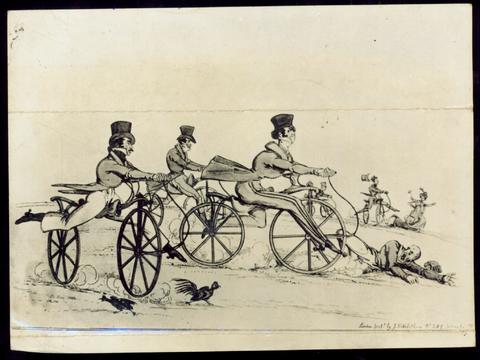
From The Running Machine to The Modern Bicycle
Fecha(s)
- 1968-02-10 (Creación)
Nivel de descripción
Unidad documental simple
Volumen y soporte
Images
Área de contexto
Nombre del productor
The Times of Ceylon Press
Historia biográfica
Historia archivística
Origen del ingreso o transferencia
Área de contenido y estructura
Alcance y contenido
A 150 years ago in January 1818, forester Karl-Friedrich von Drais received a patent for the construction of a "fast-motion vehicle". This "running machine", the forerunner of our present bicycle was made out of a wooden frame with two wheels and an upholstered saddle. The front wheel and handle-bars could be turned around entirely. The "drive" as quite simple: the daring rider pushed his way forward with his feet.
Baron von Drais's much ridiculed two-wheeler was faster than many a mail coach: He has only one hour to ride the eight miles distance between Mannheim and Schwetzingen (in the south-west of the present Federal Republic of Germany) Ten miles per hour was then held to be the highest speed a human could stand.
It took another 50 years until the wooden running machine had turned into a practical two-wheeler. English, French and German inventors participated in this development. Yet its actual victorious march around the world began 80 years ago when the Scottish veterinarian Dunlop introduced pneumatic tires.
Another milestone in the history of bicycles was set in 1900 with the discovery of the torpedo freewheel hub invented by German. E. Sachs.
Today some 150 million bicycles are in use all over he world—22 million in the federal republic alone—and its number has more than doubled the past 20 years despite increased motorization. In Denmark every second habitant owned a bicycle and in Germany every fourth, in the USA every tenth. And the greatest part of the Federal Republic's annual export of 250,000 bicycle now goes to the USA. (as of 1960)
Baron von Drais's much ridiculed two-wheeler was faster than many a mail coach: He has only one hour to ride the eight miles distance between Mannheim and Schwetzingen (in the south-west of the present Federal Republic of Germany) Ten miles per hour was then held to be the highest speed a human could stand.
It took another 50 years until the wooden running machine had turned into a practical two-wheeler. English, French and German inventors participated in this development. Yet its actual victorious march around the world began 80 years ago when the Scottish veterinarian Dunlop introduced pneumatic tires.
Another milestone in the history of bicycles was set in 1900 with the discovery of the torpedo freewheel hub invented by German. E. Sachs.
Today some 150 million bicycles are in use all over he world—22 million in the federal republic alone—and its number has more than doubled the past 20 years despite increased motorization. In Denmark every second habitant owned a bicycle and in Germany every fourth, in the USA every tenth. And the greatest part of the Federal Republic's annual export of 250,000 bicycle now goes to the USA. (as of 1960)
Valorización, destrucción y programación
Acumulaciones
Sistema de arreglo
Área de condiciones de acceso y uso
Condiciones de acceso
Condiciones
Idioma del material
Escritura del material
Notas sobre las lenguas y escrituras
Características físicas y requisitos técnicos
Instrumentos de descripción
Área de materiales relacionados
Existencia y localización de originales
Existencia y localización de copias
Unidades de descripción relacionadas
Área de notas
Puntos de acceso
Puntos de acceso por materia
Puntos de acceso por lugar
Puntos de acceso por autoridad
- The Times of Ceylon Press (Creador)
Área de control de la descripción
Identificador de la descripción
Identificador de la institución
Reglas y/o convenciones usadas
Estado de elaboración
Nivel de detalle
Fechas de creación revisión eliminación
Idioma(s)
Escritura(s)
Fuentes
Metadatos del objeto digital
Tipo de soporte
Imagen
Mime-type
image/tiff
Tamaño del archivo
17.9 MiB
Cargado
1 de junio de 2015 00:24