
Identity area
Reference code
326-IM-0059-0185
Title
From The Running Machine to The Modern Bicycle
Date(s)
- 1968-02-10 (Creation)
Level of description
Item
Extent and medium
Images
Context area
Name of creator
The Times of Ceylon Press
Biographical history
Archival history
Immediate source of acquisition or transfer
Content and structure area
Scope and content
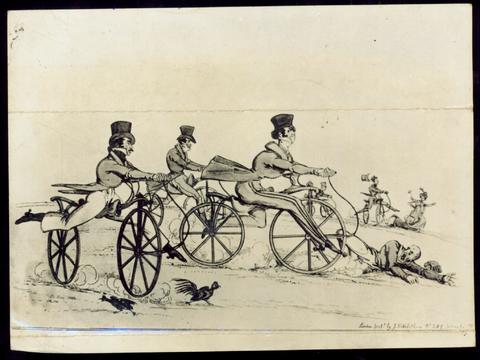
A 150 years ago in January 1818, forester Karl-Friedrich von Drais received a patent for the construction of a "fast-motion vehicle". This "running machine", the forerunner of our present bicycle was made out of a wooden frame with two wheels and an upholstered saddle. The front wheel and handle-bars could be turned around entirely. The "drive" as quite simple: the daring rider pushed his way forward with his feet.
Baron von Drais's much ridiculed two-wheeler was faster than many a mail coach: He has only one hour to ride the eight miles distance between Mannheim and Schwetzingen (in the south-west of the present Federal Republic of Germany) Ten miles per hour was then held to be the highest speed a human could stand.
It took another 50 years until the wooden running machine had turned into a practical two-wheeler. English, French and German inventors participated in this development. Yet its actual victorious march around the world began 80 years ago when the Scottish veterinarian Dunlop introduced pneumatic tires.
Another milestone in the history of bicycles was set in 1900 with the discovery of the torpedo freewheel hub invented by German. E. Sachs.
Today some 150 million bicycles are in use all over he world—22 million in the federal republic alone—and its number has more than doubled the past 20 years despite increased motorization. In Denmark every second habitant owned a bicycle and in Germany every fourth, in the USA every tenth. And the greatest part of the Federal Republic's annual export of 250,000 bicycle now goes to the USA. (as of 1960)
Baron von Drais's much ridiculed two-wheeler was faster than many a mail coach: He has only one hour to ride the eight miles distance between Mannheim and Schwetzingen (in the south-west of the present Federal Republic of Germany) Ten miles per hour was then held to be the highest speed a human could stand.
It took another 50 years until the wooden running machine had turned into a practical two-wheeler. English, French and German inventors participated in this development. Yet its actual victorious march around the world began 80 years ago when the Scottish veterinarian Dunlop introduced pneumatic tires.
Another milestone in the history of bicycles was set in 1900 with the discovery of the torpedo freewheel hub invented by German. E. Sachs.
Today some 150 million bicycles are in use all over he world—22 million in the federal republic alone—and its number has more than doubled the past 20 years despite increased motorization. In Denmark every second habitant owned a bicycle and in Germany every fourth, in the USA every tenth. And the greatest part of the Federal Republic's annual export of 250,000 bicycle now goes to the USA. (as of 1960)
Appraisal, destruction and scheduling
Accruals
System of arrangement
Conditions of access and use area
Conditions governing access
Conditions governing reproduction
Language of material
Script of material
Language and script notes
Physical characteristics and technical requirements
Finding aids
Allied materials area
Existence and location of originals
Existence and location of copies
Related units of description
Notes area
Access points
Subject access points
Place access points
Name access points
- The Times of Ceylon Press (Creator)
Description control area
Description identifier
Institution identifier
Rules and/or conventions used
Status
Level of detail
Dates of creation revision deletion
Language(s)
Script(s)
Sources
Digital object metadata
Media type
Image
Mime-type
image/tiff
Filesize
17.9 MiB
Uploaded
June 1, 2015 12:24 AM